Thursday, January 23, 2020

On receiving everything I needed

“asked for wisdom and God gave me problems to learn to solve. I asked for prosperity and God gave me a brain and brawn to work. I asked for courage and God gave me dangers to overcome. I asked for love and God gave me people to help. I asked for favours and God gave me opportunities. I received nothing I wanted. I received everything I needed.”
Lynne Twist, The Soul of Money: Transforming Your Relationship with Money and Life 

I really can't add much to this except that I recommend the book.

Cheers
Jeanne


Book Review: The Soul of Money by Lynne Twist

In the 1970s, when Lynne Twist’s children were young, her husband was a well-paid executive and her family was living the high life. They had a nice house stocked with art and a wine cellar, expensive clothes, a sports car, a nanny, and exotic vacations. Nevertheless, Twist was struck by the contrast between the wealth of her social circle and the poverty of so many others.
Her cosy life broke open after attending some talks by human potential leader Werner Erhard, who had set a 20-year goal for ending world hunger. Twist and her husband decided to re-orient their lives toward causes they believed in, and joined the work of the Hunger Project (established in 1977). Later she became involved in other initiatives such as rainforest protection, indigenous rights, and women’s leadership.
Over four decades, Twist trained over 20,000 fundraisers in 47 countries and raised over $150 million, mostly from individuals. Her work has traversed the Sahel desert in Senegal, villages and slums in India, the Rift valley in Ethiopia, Mayan villages in Guatemala, and the Amazon rainforest in Ecuador, as well as affluent countries such Sweden, France, Japan, Canada, the UK, and the US. Along the way she met the likes of Mother Teresa and the Dalai Lama, and scientist and futurist Buckminster Fuller became a mentor.
This breadth of experience brought Twist a unique perspective on how people see money around the world. Her chief insight in The Soul of Money is that money isn’t inherently bad or good, but that used wisely it has the power to transform both us and the world.
Money’s hold
Twist lived for a time with the Achuar people, who for thousands of years have lived a rich life in the rainforest with no need for actual money.
It was only when one of them stayed with her in America that she could see, through his eyes, how much of a money culture we live in. We incessantly worry about not having enough money, we define our value as people according to how much we have, we compete with each other for it, and we are addicted to consumption. Money controls us, rather than us controlling it.
It thus affects our relationships, drives wars, and leads to environmental destruction. Twist’s meeting with Mother Teresa shocked her, because she was told that part of her life’s work should be to sympathise with the wealthy, many of whom suffer isolation, mistrust, damaged relationships, and ‘hardening of the heart’.
The myth of scarcity
The root of our problem with money, Twist suggests, is a fallacious mindset of scarcity, the belief that everything is in limited supply – not just money, but material goods, time, rest, exercise, power, and love. This mindset afflicts both rich and poor, and leads to competition, mistrust, exploitation, envy, and a host of other symptoms, including the idea that ceaseless acquisition is the best way to live.
The tragedy of such thinking is that we can never step off the treadmill to appreciate what we have, and we come to value ourselves and others based on external factors rather than inner qualities. Yet Twist asserts that scarcity is a myth, a product of culture. She writes:
‘Scarcity is a lie. Independent of any actual amount of resources, it is an unexamined and false system of assumptions, opinions, and beliefs from which we view the world as a place where we are in constant danger of having our needs unmet.’
Twist’s Hunger Project has been criticised for focusing on education and mindset above actually giving out food. However, she never says that physical aid is unnecessary, only that we should try to understand the non-physical roots of poverty, a large component of which is the accepted belief in scarcity.
The truth of sufficiency
Twist moves on to the ‘surprising truth’ of sufficiency. It is rarely the actual amount of what you have, but how you use it and appreciate it that makes the difference in your prosperity. She contrasts tribes who live in abundance from their natural environment with senior women managers whom she met working at Microsoft Corporation, who despite being millionaires had a sense of constant lack in relation to time for their families.
Whereas the mindset of scarcity drives competition, the mindset of sufficiency fosters collaboration, in which everyone’s unique ability to contribute is recognised and valued, and where the outcome is win–win.
Twist mentions the success of the Hunger Project in Bangladesh to demonstrate this power of collaboration. A series of workshops helped to steer many people from feeling hopeless to instead formulating a new vision of self-sufficient communities. This vision resulted in building of roads, farms, and fisheries, reduced crime by up to 70% in some areas, and in many areas doubled incomes.
Money’s flow
Twist views money as a resource that flows like water, circulating around the world and leaving diverse consequences in its wake. Our task is to be conscious of this flow, both in our earning and spending choices. She counsels against accumulating money to too great an extent, as it becomes like a stagnant pool of water. It can no longer flow to good and useful purposes. We are naturally afraid to do this, but she gives the example of Mother Teresa, who reportedly never kept cash reserves, instead trusting that money would always come when needed, which it did.
In this context, fundraising is not simply about coaxing people to donate money, perhaps even against their will, but rather about helping them to ‘engage in their greatness’ through the effective flow of their money. Twist once returned a check for $50,000 that she received from a corporation because she perceived it to be ‘guilt money’, designed to take attention away from the company’s moral failings.
Real awareness of money’s flow rules out blithely handing over money or food to people. At a practical level, this can actually worsen their long-term prospects by making them dependent on such ‘aid’. The better way is to help them raise themselves to a level of self-sufficiency through a partnership based on mutual respect.
Final comments
Having spent decades travelling the world and seeing the best and the worst of money’s power, Twist remains optimistic. Her book reinforces the distinction between wealth and money on one hand, and prosperity on the other. Whereas a hungry pursuit of the first can cause terrible damage to our souls, a focus on the second –which involves an appreciation that there is enough for everyone – can enrich us spiritually and emotionally.
There are now quite a few books on the meaning of money in our lives, but what sets The Soul of Money apart is Twist’s experience of the extremes of wealth and poverty. With many personal stories and a compassionate voice, the book does not claim to be a scholarly work on the role of money. Some may find it too mystical, yet it is an engrossing read that will have you thinking more deeply about your unconscious attitudes, and how you can use money as a healing rather than a destructive power

In a similar vein

Charles Fillmore Prosperity
Charles Fillmore
Joel T. Fleishman The Foundation
Muhammad Yunus Banker to the Poor

Biography: Lynne Twist

Twist was born in 1945.
Apart from her role with the New York-based Hunger Project (which has Nobel Prize-winning economist Amartya Sen and Queen Noor of Jordan on its board), she has also been a vice chair of the Institute of Noetic Sciences, co-founder of the Pachamama Alliance to empower indigenous people to preserve the Amazon rainforest, and president of the Turning Tide Coalition.
Her Soul of Money Institute was established in 2003, and runs workshops and seminars. Twist is also a contributor to the book The Soul of Business. She is married with three adult children and lives in San Francisco.

Thursday, December 19, 2019

Curiouser

“The whole problem with the world is that fools and fanatics are always so certain of themselves, and wiser people so full of doubts.”

Bertrand Russell

Everything gets "curiouser and curiouser" (Lewis Carroll, Alice in Wonderland). Why, as we grow up, do we want things to be explained and why do we want to be 'right' and label everything; good/bad, right/wrong, pretty/ugly, happy/sad, scary/safe...??

I think we really are all 'mad' and this is a function of our creative, vulnerable, unique, inside sparks which get buried under the rubble of the 'things' we think we 'know'. The more we think we know the deeper we get stuck in a world of our own creation instead of a place of magic where every sunrise is different and trees can talk ... where its okay not to know the answers or what is going to happen tomorrow ... where we can cry and laugh in the same moment about the same thing and where funny little inspirations can jump out at random times and places and there are always multiple paths we can choose to take us places we haven't even dreamed of yet.

Warm wishes for a wonderful, imaginative, curious, loving Christmas time to all.

Jeanne

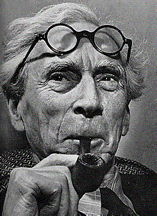
Bertrand Russell


Photo of Bertrand Russell


Photo by Larry Burrows
Bertrand Russell

First published Thu Dec 7, 1995; substantive revision Thu Jun 29, 2017

Bertrand Arthur William Russell (1872–1970) was a British philosopher, logician, essayist and social critic best known for his work in mathematical logic and analytic philosophy. His most influential contributions include his championing of logicism (the view that mathematics is in some important sense reducible to logic), his refining of Gottlob Frege’s predicate calculus (which still forms the basis of most contemporary systems of logic), his defense of neutral monism (the view that the world consists of just one type of substance which is neither exclusively mental nor exclusively physical), and his theories of definite descriptions, logical atomism and logical types.

Together with G.E. Moore, Russell is generally recognized as one of the main founders of modern analytic philosophy. His famous paradox, theory of types, and work with A.N. Whitehead on Principia Mathematica reinvigorated the study of logic throughout the twentieth century (Schilpp 1944, xiii; Wilczek 2010, 74).

Over the course of a long career, Russell also made significant contributions to a broad range of other subjects, including ethics, politics, educational theory, the history of ideas and religious studies, cheerfully ignoring Hooke’s admonition to the Royal Society against “meddling with Divinity, Metaphysics, Moralls, Politicks, Grammar, Rhetorick, or Logick” (Kreisel 1973, 24). In addition, generations of general readers have benefited from his many popular writings on a wide variety of topics in both the humanities and the natural sciences. Like Voltaire, to whom he has been compared (Times of London 1970, 12)), he wrote with style and wit and had enormous influence.

After a life marked by controversy—including dismissals from both Trinity College, Cambridge, and City College, New York—Russell was awarded the Order of Merit in 1949 and the Nobel Prize for Literature in 1950. Noted also for his many spirited anti-nuclear protests and for his campaign against western involvement in the Vietnam War, Russell remained a prominent public figure until his death at the age of 97.

https://plato.stanford.edu/entries/russell/


Monday, December 16, 2019

Just Appreciate

I recently spoke at a local high school to explain to the students what it feels like to live with a disability. I want everyone to understand that being different isn’t scary or weird”  
Jamie Perrenoud

Found another hero!! I learned of Jamie when he spoke briefly at an event. He was notable before he spoke by the energy that emanated from him, then when he spoke the enthusiasm and earnestness of his message really brought home his message. Bullying hurts people! I expect that more of us than will ever admit have faced bullying of some sort during our lives and there are deep scars covering dark places inside us where once we innocently expected that we would be accepted as we are. Jamie's reaction and actions to address bullying are inspiring and full of what I call "grace". Instead of withdrawing into a shell he is choosing to shine a light on the inside of his experience. He is courageously putting his most vulnerable self out to help the world see that others "differences" are not to be feared or ridiculed. Thank you Jamie, may you inspire both bullies and those subject to bullying to shine a light on their fear. It is the responsibility of all of us to deal with this epidemic in our competitive, materialistic, egocentric society where values are so topsy-turvey that we need to be reminded that judgement, hatred and bullying breeds more fear and hatred and are anathema to appreciation, love, respect and any chance of peace. 
Cheers
Jeanne


Cerebral Palsy Doesn’t Define Life of Jamie Perrenoud

Jamie started his own T-shirt business with a clear message: “Don’t judge, Don’t hate, Don’t bully.”

Article & Images by Gareth Vieira

Jamie Perrenoud is a 32-year-old man who lives with Cerebral Palsy, and while this diagnosis is an aspect of his life, it doesn’t define his life. What defines him is his determination to beat the odds, to make a difference, and to speak out with a creative spirit for people of different abilities

“I have been bullied and judged all my life,” said Jamie.
“So I took it upon myself to make a difference. I’m fighting for every individual that lives with a disability, every day, like me and anyone who has been bullied.”
  With this view as his framework, Jamie started his own T-shirt business with a clear message: don’t judge, don’t hate, don’t bully, just appreciate. “If enough people wear the T-shirts it might make a difference in how people treat each other,” said Jamie. The money raised from T-shirt sales will be donated to the March of Dimes and Community Living in Ontario to develop day programs for the differently-abled.

Jamie is living proof of that old adage, you practice what you preach, and his advocacy for people living with disabilities is a ceaseless testament to that as he brings awareness to many causes and movements that are important to him.
“I recently spoke at a local high school to explain to the students what it feels like to live with a disability. I want everyone to understand that being different isn’t scary or weird,” said Jamie.

Jamie’s parents, Charlotte and Pierre, both say that from a young age Jamie has always had a spark of enthusiasm when it came to supporting causes that could bring attention to people with special needs.

“Diagnosed with Cerebral Palsy at a young age Jamie, never let it get in his way.” says his father Pierre. “Jamie has one of those personalities that is not deterred easily and I get the feeling when someone says something can’t be done, he not only shows them that it can but how it can be done better and along the way clears a path for others who want to embark on a similar road.”

Jamie was a founding member of the special needs rock band Superfire. They played to school audiences and at rock venues. The band recorded two CD’s of original music, with Jamie contributing a good number of songs, said his father adds.

Jamie’s foray into fundraising as a means to expose stereotypes and intolerance began several years ago when he undertook his first T-shirt fundraiser, donating over $800 to the March of Dimes.

“With the success of that first T-shirt fundraiser, Jamie embarked on his latest venture “J.A.M.” (Just Appreciate Movement) The message Jamie is putting out there is to appreciate people different from yourself,” said Charlotte.

In December of last year, Jamie donated $310 to Community Living Burlington for their special needs music program, and his donation was matched by an anonymous donor. His parents say the shirts have truly resonated with those that see negative behaviour towards others, as just not acceptable.

Jamie proves that having a disability, whether it be physical, mental, visible or invisible, includes a broad spectrum of people, and while the difficulties navigating a disability can be hard, a disability is just a single facet of who we are, not all we are. We are connected, yet different, and it’s our differences that make us special and unique.

Friday, December 06, 2019

Lists from Naive. Super

It might be fun to do lists like the ones in Naiive Super by Erlend Loe

1. a list of what we have and what we don't have
2. a list of qualities for an object that will make us think about nice things, or preferably just smile
3. a list of what used to excite us when we were younger
4. A list of who we look up to
5. A list of what we know a lot about
6. A list of animals we've seen lol with or without insects this could take a long time!
7. A list of what we would paint if we were a painter
8. A list of qualities for something that would redress the damage done by a "bad" friend
9. A list of things we have in our room/house of things we are not using
10. A list of things that should never be animated in a commercial context
11. A list of things we appreciate
12. A list of things that make us happy
13. A list of things that are big and long and tall in a city/ place we visit
14. A list of things we remember from the day
15. A list of companies and products we love

Thursday, December 05, 2019

A Beautiful Day in the Neighborhood

“Love isn’t a state of perfect caring. It is an active noun like struggle. To love someone is to strive to accept that person exactly the way he or she is, right here and now.”  

Fred Rogers

We saw the movie "A Beautiful Day in the Neighborhood" last night so, of course, you get a Mr Rogers quote today. I've been anticipating this movie since I sent a Mr. Rogers quote earlier this year. I am adding this to my favourite movies of all time list to be watched during the Christmas season. Why "favourite" and why "Christmas" are encapsulated in the above quote. Adding "to love ourselves" exactly as we are and "to love our world" exactly as it is to the concept "to love someone" completes the picture of the epic struggle between love as challenging us to love the way we want to be loved and our expectations of perfection in what we love.

Christmas is when I have less demands on my time, but in the dark evenings I spend alone I can feel really alone and sometimes I decide to look at my unlovable-ness, because if I was loved someone would want to be with me. Doesn't make sense, but serves a purpose because that's when I explore the world and myself.
 
Those evenings I spend reading, listening to music and thinking. Maybe for a bit I'll cry about being alone; then I'll hear my mother's voice telling me to get over myself (which I didn't appreciate hearing when I was a teen) but now makes me laugh and feel blessed to have been loved unconditionally by a wise, beautiful, strong woman. I love these evenings because she feels so close. Sometimes I dance because music takes me somewhere to another emotional experience. Sometimes everything seems so hopeless, the world seems to have given up on love and gotten stuck in patterns of competition, greed, cruelty, pain, and hunger and to have buried a deep and unconscious need for love in looking for substitute value in a material world. Broken people and places around the globe that are stuck in patterns of hate because it is hard work to love broken things and it is hardest to love ourselves in our own brokenness.  

Those are the times I watch one of my Christmas movies like "Love Actually".  It is a movie about many kinds of love, loneliness, struggle and forgiveness... and illustrates that love is not easy and people can't help but be who they are and every single one of them is lovable and has the capacity for loving others beyond what they seem to be and do. (and because it makes me laugh and cry)

"A Beautiful Day in the Neighbourhood" made me cry, remember the child I was, remember the times when everything in my world seemed fragmented and a common experience brought people together in a few minutes of shared consciousness. There's a couple links below about the story and the movie ... 

There is something magical about these movies that make people believe in love, at least for a little while, and that is the Christmas season to me.
Thank you to all the inspiring people and movies and songs that help us believe in love.
Cheers
Jeanne

Check these out:

Thursday, November 28, 2019

There is always room for discovery

"There’s wisdom in acknowledging that even if you passionately believe something, there’s room for possibility, for discovery, for progress."
Maarten van Doorn

It is such a confusing world of conflicting voices and the chaos of people and governments justifying opposing theories is crazy making.  I appreciate the above quote and the accompanying read that goes with it (if you follow the link below) for this. Basically this quote says to me that once we formulate what we believe in it is not the stopping point, this does not become an absolute belief that we have to defend and support ad infinitum. It is merely the starting point!!!
And, I think there is always room for more thinking, reading, and listening to what's underneath the babble ...
Cheers
Jeanne

"Thinking begins when you ask really difficult questions."
SLAVOJ ZIZEK, "Slavoj Zizek: I am not the world's hippest philosopher!", Salon, Dec. 29, 2012 http://www.notable-quotes.com/z/zizek_slavoj_ii.html
(Slovenian Marxist Philospher) I will definitely be reading more of Zizek's writing... although I have always blindly assumed Marxism was one of the ideologies that took away the Individual freedoms we value so highly in our democratic society. Haha here's a whole new tangent ... 

Maartan van Doorn
Medium member since Mar 2018
PhD candidate in philosophy. Reconsidering the obvious. Chasing interestingness. 
Get good ideas that make you think

Wednesday, November 27, 2019

A Wife's Tale by Aida Edmarian

Thank you Erin  for hosting Bookclub evening for The Wife's Tale by Aida Edemarian

I really appreciate all the work you went to for the authentic Ethiopian meal. It was a real treat, and added another dimension to the story of Yetemengu's life. Not only was feeding people so much work it was also as much a cultural experience as was eating the food, the spices and flavours so warm and delicious and nutritious! I wonder what it was like for her son when he came to Canada to eat the food he had access to here...

I did love the sparks we saw that she had a sense of humour and imagination, despite a life that seemed filled from a very early age with dour drudgery, violence, and injustice. Her indomitable spirit as well as her intelligence was what gave her family the opportunity to excel in their education and vocations. Quite inspiring! 

The other thing my mind keeps wandering back to as I read these and other stories is that judgement and comparison really don't serve us unless they make us feel grateful for where we are and more empathetic to others. To me reading this story was experiential rather than just an outside view into a life. Even though many of  Yetemengu's references; spiritual, historical, religious and family were obscure I don't know that having the confusion explained away would have helped me with the meta experience of the book, I still got the take away of a little more understanding of a life lived so very different than mine.  

We read history; details about the events and timelines of wars, revolutions, changes to new political regimes. To read about the day to day life and need to flee one's home and how a family adapts to all the events takes these events from the realm of facts and dates to individual lives lived. A valuable insight to assist in seeing the similarities of mother's and that feeding our family and education for our children is a universal concern and we all value the same things despite cultural and religious differences.

I am halfway through reading "Boy Swallows Universe" by Trent Dalton. A thought provoking journey through a young life, intense and hard to put down. It would be great for our bookclub, although I'm not so sure about some of the food; there is a Vietnamese feast with snake's head among the many dishes...some things make you gag, but are perfect in the context, both real and allegorical... every paragraph is a full of beautifully crafted descriptions and feelings. It is a full on pleasure to read 

Here are the links to the Ethiopian dishes:
First I made the Berbere spice: https://www.daringgourmet.com/berbere-ethiopian-spice-blend/
and the Niter Kibbehhttps://www.daringgourmet.com/niter-kibbeh-ethiopian-spiced-clarified-butter/
used in the following dishes…
Mesir Wat – Spiced Red Lentils:https://www.daringgourmet.com/misir-wat-ethiopian-spiced-red-lentils/
I used this recipe for the Ayib -Ethiopian Cheesehttps://www.aspicyperspective.com/ethiopian-recipes/
Doro Wat -Ethiopian Spiced Chicken: https://www.daringgourmet.com/doro-wat-spicy-ethiopian-chicken-stew/(The recipe suggests adding hard boiled eggs, but I decided to not include since I had seen Doro Wat also prepared without them)
Gomen – Collard Greens:https://www.daringgourmet.com/gomen-ethiopian-collard-greens/
And for dessert: Ethiopian Coffee-Infused Coffee Cake with Vanilla Ice Cream:
https://www.yummy-africa.com/recipes/2019/4/12/ethiopian-coffee-infused-coffee-cake
I didn’t have Yirgacheffe coffee on hand but believe you can get it at Ten Thousand Villages. I like the French Roast from there for my morning latte, so used that. Beware: there is a mistake in the baking time … it take about 45-50 minutes (not 20 minutes) in a Bundt pan. The recipe serves about double the number suggested (5-7 for a large Bundt cake seems like humungous servings!)
I had planned to make Injera but ran out of time… and instead served fried Parathafrom the frozen food section.
However, this looks reasonably straight forward to make…  I thought the other Doro Wat recipe looked better using the traditional spices and clarified butter: 
https://www.aspicyperspective.com/ethiopian-recipes-injera-doro-wat/
For the Injera Recipe:
  • In a large bowl, mix both flours, salt and baking soda together. Whisk in the club soda until smooth. Then add the vinegar and whisk. 
  • In a large skillet over medium heat. Pour oil on a paper towel and wipe the skillet with the oiled paper towel.
  • Using a scoop, pour batter into the skillet creating a 6-inch circle. Carefully swirl the pan around to thin out the batter until it measures 8- to 9-inches across.
  • Cook for 1 minute, then using a large spatula, flip the Injera over and cook another minute. Remove from the skillet and stack on a plate. Repeat with remaining batter. The Injera will seem slightly crisp in the pan, but will soften immediately when placed on the plate.
  • Once finished cooking the Injera. Cut the circles in half with a pizza cutter, roll into tubes and stack. Keep warm until ready to serve. Serve the Doro Wat and Injera together, tearing piece of Injera and using it to pick up the Doro Wat.

Thursday, November 21, 2019

Freedom of Speech; my response to Don Cherry controversy

“True power is living the realization that you are your own healer, hero, and leader.” 
Yung Pueblo  

My father in law was a hero in many ways. He served in the Canadian Armed Forces in the Second World War in the Reconnaissance; C Squadron, 11 troop, 8th Recce.  He was 18 years old when he signed up. Theo was injured near Caen in France in 1944 about a month after D Day, about 8 o'clock in the evening on July 15th. He was hit by several pieces of shrapnel from a bomb and one piece lodged in his spine. Paralysis in those days was incurable, basically those unfortunate enough to be para or quadriplegic from their injuries were put in a bed and never got out again, their bodies gradually shutting down until they died, on average they lived about two years. Theo never accepted this and he was his own healer, hero and leader, never giving up faith that he could walk again. He did it and forged a path for others to fight for their recoveries as well!  Through his force of will, determination and seriously hard work and though pain and complications continued throughout his life he continually beat all the odds and lived into his nineties. The strength and power he demonstrated from his choice to own his life was inspirational. The love he had for his family and friends, the many kindnesses he did for people that no one knew about, the values that he chose to live by pragmatically and without drama were dependable and constant. 

Underneath a gruff, abrupt and sometimes judgmental exterior remained that idealistic 18 year old boy who never lost his belief that we choose how we live; despite seeing many friends and enemies injured, killed and mentally damaged beyond hope in violent conflict where human lives were sacrificed in a war machine that was caused by hate, inequality and leaders manipulating divisiveness and fear between groups of people ... and for what?? Why did these boys have to fight for freedom?? Because of a power corrupted by greed and fear that used peoples differences to blame, fear, and ridicule another group, to promote a 'superior race'.

Yes I believe in free speech in its essence. But I believe that speech should never belittle, condemn or abuse another individual or group of people. Freedom of Speech is a privilege. It is not a vehicle to condemn other people. Compassion and empathy should be the basis for free speech. Confusion and fear are exaggerated and corrupted when "free speech" is used to separate "us" from "them". Those who fought for our freedom did not fight for one particular religion, culture, race, colour, handicap, gender, sexual preference, language, mental state or other belief that excludes or discriminates against a people. They fought for the right to be free to choose and live without persecution for those choices. 

The fastest way to lose the privilege of freedom of speech is to abuse it. If you are the abuser you may keep it for a while and shut up dissenting voices, but in the end this is what causes divisiveness, power struggles and wars. 

Not one of us has a divine right to be the judge of other people and it takes a vigilance to recognize in ourselves what we condemn and fear in others and be our own healer, hero and leader.

With love and In Remembrance
Jeanne
                

YUNG PUEBLO
 
diego perez is the writer behind the pen name yung pueblo. the name yung pueblo means “young people.” it serves to remind him of his ecuadorian roots, his experiences in activism, and that the collective of humanity is in the midst of important growth. his favorite word, liberation, took on a deeper meaning once he started meditating vipassana. through writing and speaking, he aims to support the healing of the individual, realizing that when we release our personal burdens, we contribute to a global peace.

Instagram: @yung_pueblo 

What to do to be successful

"If you consistently put unhealthy foods in your body, your body will become unhealthy. You body is a natural system governed by principles.
If you don’t pay the price to develop your mind with consistent learning, your mind will become dull and unclear. Your mind is a natural system governed by principles.
The law of the harvest is always in effect. What you plant, you must harvest. Furthermore, what you plant consistently over time eventually yields a compounded or exponential harvest."
Benjamin Hardy

This morning I was looking for a quote I read that didn't make sense at the time,but after reading and pondering it for a few days it hit me on the head, with a brick!.. and I can't find it now or remember the trail I was on when I read it. From memory paraphrasing: Successful people get successful by doing the things that no one wants to do. (a glimmer is emerging; it was from a Life Insurance company training talk, how I got there I'm not sure) Loosely interpreting, the author used the example that No One likes cold calling for sales leads. The successful insurance salesperson is the one who makes this into the number one thing they do. HA - makes sense... however, they don't think every morning "okay I'm going to do that thing I don't want to do" ... they take their ego out of the picture and don't think about what makes them feel bad, like the many rejections they'll get all day. They maybe say to themselves each morning that they are going to give 50 households the opportunity to purchase this benefit for their family and if even one person a week listens to them it is worth it. (This is not sales training by Jeanne, it is an illustration only)

There are a hundred directions I can go with this... but back to today's quote: we reap what we sow, which is the same as the above illustration in different words.

Thinking about where I want to go, what I want to do and who I want to be ... there is not so far between here and there. What lies in the way is a story I've made up in my mind about what I can and can not do. All I really have to do is that which I don't want to do; the hard thing, the obstacle in my way, the impossible, the thing that some people are genetically predisposed to do but I can't ... the excuses that I manufacture to stay in the comfort zone of wanting but not challenging my status quo to make the leap... the addiction of continuing the habits of my thinking that circle me around but keep me away from what it takes to be whatever my gut and heart tell me are "successful". The thing is we are in our own way, and we know how to get out of it, we just think its too hard.

The Wizard of Oz could say; no one can give it to you, its in you already, all you need to do is trust and follow that yellow brick road on your own quest ... or something could call us to dive down a rabbit hole like Alice and trust that we can grow or shrink or somehow deal with whatever adventures show up. And if we are waiting for the golden path or the inviting rabbit hole to show up... well hey (picture slap on the head) they are already there, in that niggling thing in the back of our head that we are making excuses for not doing and will lead us into the uncomfortable territory of finding out how much more we can be!

Cheers
Jeanne

About Benjamin Hardy

”Success isn’t that difficult; it merely involves taking twenty steps in a singular direction. Most people take one step in twenty directions. If you want a different life, you must be a different person.” –Benjamin Hardy
 Hardy earned a Bachelor of Science degree in Psychology in 2013 from Brigham Young University. In 2018, he graduated from Clemson University with the Doctor of Philosophy (Ph.D.) degree in Industrial and Organizational Psychology.

MEET BENJAMIN HARDY, PHD

Hello and welcome!
In February of 2018, my wife Lauren and I adopted our oldest three kids from the foster system after a long, painful, and miraculous court battle. One month after the adoption, Lauren got pregnant with twins who were born in December.
So in 2018, we went from officially having 0 kids to having 5!
I’m an organizational psychologist and bestselling author of Willpower Doesn’t Work.
My work is viewed by millions of people monthly and featured on Forbes, Fortune, CNBC, Cheddar, Big Think, and many others. I am a regular contributor to Inc. and Psychology Today.
From 2015 to 2018, I grew my email list to nearly 400,000 people (without paid advertising) as the #1 writer in the world on Medium.com.
Enjoy my website and the articles and resources here. Also, as a personal invitation to transform your past trauma and 10X your future identity, you can watch my 45-minute webinar here.
The Hardy Family

Friday, November 08, 2019

Routine lethal

“If you think adventure is dangerous, try routine, it's lethal" 
Paulo Coelho

Definitely one of my favourite authors of all time Paulo Coelho comes through with the perfect quote for the occasion. Today my daughter is leaving on her travels south with her dog Ziggy. She a great inspiration for listening to the call of adventure. It really takes me out of my comfort zone that she goes on these trips and I know I won't see her for months, but I remind myself constantly that she is "Naturally creative, resourceful and whole"* and the biggest service I can do for her is emotionally support her choices and send her off with blessings and love. 
Cheers
Jeanne

*That "People are naturally creative, resourceful and whole" is a cornerstone of the coaching model from the Coaches Training Institute which I did my coaches training through over fifteen years ago now. This 'cornerstone' is still something I consciously remind myself of when I find I'm trying to fix people and situations, particularly for my kids.
Here' s a couple bonus quotes for today, to help get through those times stuck in the routine of whatever comfort zone we are in.

"People have a hard time letting go of their suffering. Out of a fear of the unknown, they prefer suffering that is familiar." ~ Thich Nhat Hanh 
If we practice mindfullness, we always have a place to "be" when we are afraid" ~ Thich Nhat Hanh
 
The Thich Nhat Hanh quotes I found on the following blog when I was wandering around google for "creative resourceful and whole"

Need a Heart? Listen to the Tin Woodman

“Thereafter he walked very carefully, with his eyes on the road, and when he saw a tiny ant toiling by he would step over it, so as not to harm it. The Tin Woodman knew very well he had no heart, and therefore he took great care never to be cruel or unkind to anything. "You people with hearts," he said, "have something to guide you, and need never do wrong; but I have no heart, and so I must be very careful. When Oz gives me a heart of course I needn't mind so much.”
L. Frank Baum, The Wonderful Wizard of Oz  

I think the Tin Woodman could be our heart guide
Cheers

NO limits to who you can become

"Our past shapes and influences who we are, but it doesn't limit who we can become"
Arlene Dickinson

How great is this?!! We can always become something new, reinvent ourselves and move beyond any limits! ANY!! ALWAYS!!
One of the most transformative things in my life happened about 15 years ago when a friend did a short bio of me for a project we were doing. She described my life in a way I had never seen myself... I actually started arguing with her about it, before I shut myself up, said "Thank you"! I am still consciously reminding myself of this story every time I sink into the old comfort zone of using my insecurities from the past as an excuse to not do the things my imagination comes up with. 
Arlene Dickinson is inspirational as someone who has reinvented herself and become so much more than her earlier self could ever dream. She has written a book "Persuasion A New Approach to Changing Minds" which I randomly chose to pick up at a used bookstore. There are many quote worthy ideas in this book... you may not have heard the last ...
Cheers
Jeanne

Persuasion: A New Approach to Changing Minds

 3.74  ·   Rating details ·  645 ratings  ·  66 reviews
At thirty, Arlene Dickinson found herself stranded. Recently divorced, she had a high school diploma, no savings and no clue how she was going to feed four young children. But just one year later, she was a partner in Venture Communications. Ten years on, she was CEO, poised to grow the business into one of Canada’s largest independently owned marketing firms. Today, as a co-star of the CBC TV hit Dragons’ Den, she is one of the country’s most sought-after female entrepreneurs. The secret of her journey from poverty to the corner office? The art of persuasion, as she explains with wit and unusual candour in this, her first book.

Blending her own frank and highly entertaining stories with compelling social science, she explains how to persuade both in the boardroom and in everyday life: the crucial importance of a particular kind of listening; how to get people to buy into your ideas; how to attract followers and deal with naysayers; the art of storytelling; how to turn mistakes to your advantage; and how to seize opportunities where others see only roadblocks. Anyone, she believes, can be persuasive—just look how good we are at persuading ourselves we can’t do things. Using the tricks of her trade and insights from her own fascinating experiences with some of Canada’s leading companies, Dickinson explains how to master the art of persuasion, without an M.B.A., to achieve maximum success in business—and in life.

Here's a bonus article I came across in Arlene Dickinson's latest Digest at https://arlenedickinson.com
I feel the following article could be posted as a reminder for us to see everyday!


13 Ways We Justify, Rationalize, or Ignore Negative Feedback

FEBRUARY 14, 2019
Everybody loves feedback . . . as long as it’s positive.

But most of us dislike negative feedback so much that we’ve even changed the name — it’s not negative, it’s constructive.

Still, it’s an irreplaceably valuable gift.

We need to know when we are doing things that don’t land the way we planned.

When our impact veers from our intention. And the best — often times the only — way to discover that gap is through feedback.

That said, chances are you fight against it.

It doesn’t feel good to be told you missed the mark. And, since feedback often uncovers our blind spots, it’s especially jarring because, in many cases, we thought we were doing a good job. So we don’t immediately or intuitively agree with the validity of it (we tend not to believe things we can’t see ourselves).

This is especially true for leaders who, because of rank and power, don’t often get told the whole truth.

So, it’s not unusual for leaders to get defensive when we hear criticism about our leadership. It doesn’t fit with the story we tell ourselves.

In order to understand this issue more intimately, I asked the person I work most closely with to give me negative feedback, to expose one of my blind spots.

I took a breath and readied myself. I wanted to go slowly and notice everything that happened in my mind and my body.

“You work too hard,” She said. As criticism goes, this was a softball.

Still, here’s what happened:

That’s a compliment, I thought, not a criticism. She was trying to tell me that I am acting in ways that are unsustainable for me and for the organization, but my protective response was pride.

That thought was quickly followed by another: She doesn’t work hard enough! I de-validated her feedback by de-validating her. It’s not that she’s insightful, my ego decided, it’s that her bar is not high enough.

And then another thought: I have to work so hard because the business depends on me. I made excuses to justify why I act the way I do. In other words, sure I work too hard but it’s not my fault.

Meanwhile I felt a squirrelly feeling in my abdomen and could feel the vulnerability of not being perfect. It was subtle but definitely a felt experience. A physical reaction, a feeling that something wasn’t right.

As an executive coach who helps successful people become great leaders and create more effective teams, I’m often in the position to give people feedback that’s hard to hear.

As I thought about my own reaction, as well as the reactions I often hear from clients, I began to list the common things we say (or think) when hearing negative feedback to defend against new information that threatens the way we see ourselves:

  • Play Victim: “Yes, that’s true, but it’s not my fault.”
  • Take Pride: “Yes, that’s true, but it’s a good thing.”
  • Minimize: “It’s really not such a big deal.”
  • Deny: “I don’t do that!”
  • Avoid: “I don’t need this job!”
  • Blame: “The problem is the people around me. I hire badly.”
  • Counter: “There are lots of examples of me acting differently.”
  • Attack: “I may have done this (awful thing), but you did this (other awful thing).”
  • Negate: “You don’t really know anything about X.”
  • Deflect: “That’s not the real issue.”
  • Invalidate: “I’ve asked others and nobody agrees with the feedback.
  • Joke: “I never knew I was such a jerk.”
  • Exaggerate: “This is terrible, I’m really awful.”

If you ever notice yourself saying, or thinking, any of the above, it’s a clear sign that your ego is getting in the way of an important learning.A lot has been written about how to receive feedback well, some of it quite nuanced. But once our ego is involved, and we feel the emotional charge, it’s hard to access nuance.

What we need, is a simple, reliable, default response:“I really appreciate you taking the time and the effort to tell me. Thank you.”Isn’t that the way you would want someone to respond after you gave them a gift? Accept the gift (in this case, that means listen), and then say “thank you.” That’s it.
This response communicates to people that it’s safe to offer you feedback and they will be far more likely to speak directly to you, instead of behind your back.

There’s also an almost magical added benefit to this simple, undefended response: It dramatically increases your ability to take in the feedback. When you stop defending against it externally, you actually stop defending against it internally too.

After my colleague told me, “You work too hard,” and I quietly observed all my own defensive reactions, I followed my own advice. “I really appreciate you taking the time and the effort to tell me,” I said. “Thank you.”

The result? She thanked me for receiving it so well and I’ve actually begun to put less pressure on myself and others.

Maybe that’s why they call it constructive feedback after all.