Thursday, May 07, 2020

Who wants Easier?

“There are a hundred paths through the world that are easier than loving. But, who wants easier?”
― Mary Oliver, New and Selected Poems, Volume One  

“Have I lived enough?
Have I loved enough?
Have I considered Right Action enough, have I
come to any conclusion?
Have I experienced happiness with sufficient gratitude?
Have I endured loneliness with grace? 
- A Thousand Mornings, Mary Oliver

What does it mean to be alive? How do we awake to a life that fills us in the way we long for?
I think that the world is telling us to Wake Up and find the courage to be who we need to be to break away from the chains of being a superior human and thinking the world was created for us. It is calling for us to take our humble place in this world; we are no more and no less important than the tiniest and simplest of creatures, and when we cherish all we cherish ourselves. 
Go forth and cherish
Jeanne

About Mary Oliver

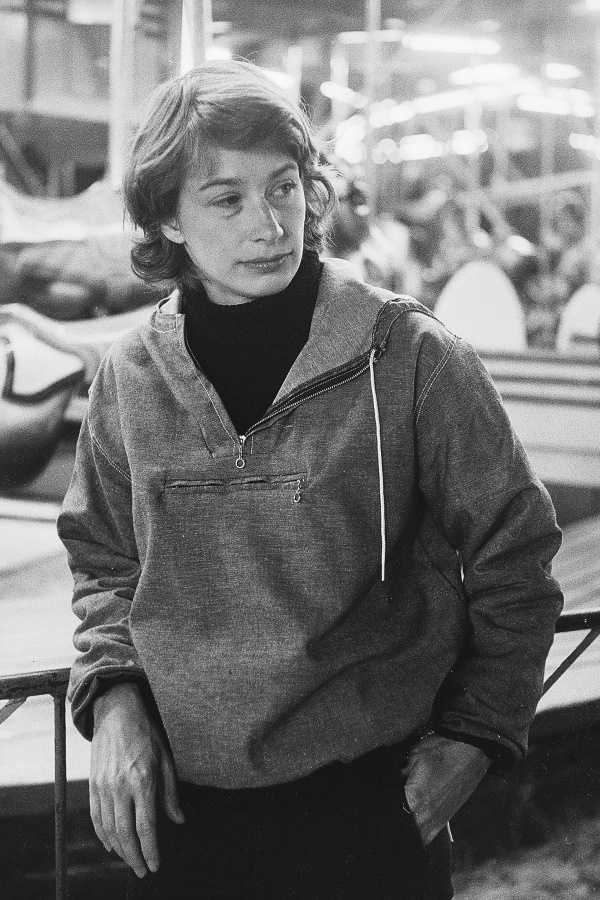
Mary Oliver, photo by Molly Malone Cook

Summer, 1964. Photo by Molly Malone Cook, from Our World (Beacon Press, 2007).

A private person by nature, Mary Oliver has given very few interviews over the years. Instead, she prefers to let her work speak for itself. And speak it has, for the past five decades, to countless readers. The New York Times recently acknowledged Mary Oliver as “far and away, this country’s best-selling poet.” Born in a small town in Ohio, Oliver published her first book of poetry in 1963 at the age of 28; No Voyage and Other Poems, originally printed in the UK by Dent Press, was reissued in the United States in 1965 by Houghton Mifflin. Oliver has since published many works of poetry and prose (the complete list appears below).

As a young woman, Oliver studied at Ohio State University and Vassar College, but took no degree. She lived for several years at the home of Edna St. Vincent Millay in upper New York state, companion to the poet’s sister Norma Millay. It was there, in the late ’50s, that she met photographer Molly Malone Cook. For more than forty years, Cook and Oliver made their home together, largely in Provincetown, Massachusetts, where they lived until Cook’s death in 2005.

Over the course of her long and illustrious career, Oliver has received numerous awards. Her fourth book, American Primitive, won the Pulitzer Prize for Poetry in 1984. She has also received the Shelley Memorial Award; a Guggenheim Fellowship; an American Academy and Institute of Arts and Letters Achievement Award; the Christopher Award and the L.L. Winship/PEN New England Award for House of Light; the National Book Award for New and Selected Poems; a Lannan Foundation Literary Award; and the New England Booksellers Association Award for Literary Excellence.

Oliver’s essays have appeared in Best American Essays 1996, 1998, 2001; the Anchor Essay Annual 1998, as well as OrionOnearth and other periodicals. Oliver was editor of Best American Essays 2009.

Oliver’s books on the craft of poetry, A Poetry Handbook and Rules for the Dance, are used widely in writing programs. She is an acclaimed reader and has read in practically every state as well as other countries. She has led workshops at various colleges and universities, and held residencies at Case Western Reserve University, Bucknell University, University of Cincinnati, and Sweet Briar College. From 1995, for five years, she held the Catharine Osgood Foster Chair for Distinguished Teaching at Bennington College. She has been awarded Honorary Doctorates from The Art Institute of Boston (1998), Dartmouth College (2007) and Tufts University (2008). Oliver currently lives in Provincetown, Massachusetts, the inspiration for much of her work. (Mary Oliver died January 17th, 2019)


"Wild Geese" by Mary Oliver

You do not have to be good.

You do not have to walk on your knees 

for a hundred miles through the desert, repenting.

You only have to let the soft animal of your body

     love what it loves.                         

Tell me about despair, yours, and I will tell you mine.

Meanwhile the world goes on.

Meanwhile the sun and the clear pebbles of the rain

are moving across the landscapes,

over the prairies and the deep trees,

the mountains and the rivers.

Meanwhile the wild geese, high in the clean blue air,

are heading home again.

Whoever you are, no matter how lonely,

the world offers itself to your imagination,

calls to you like the wild geese, harsh and exciting—

over and over announcing your place

in the family of things.


Cheers
Jeanne

Thursday, April 30, 2020

Possibility

"Don't be put off by people who know what is not possible. Do what needs to be done, and check to see if it was impossible only after you are done."
Paul Hawken

Thoughts for a Thursday morning in the sixth week of the COVID 19 Pandemic Stay Home Save Lives world: 

What if we respond to a suggestion or idea put forward by a friend, our children, anyone ... with; let's see what's good about this and a genuine interest and detached ego, rather than shooting it down with all the impediments that come to mind? 

Hey, what if we stopped trying to have all the answers and let some of our questions lead us to curious and exploratory places and embrace not knowing so we can find out more and not limit ourselves to what we believe we know. 

What if Interest, Curiousity and Learning could be come our natural state?? 

What if we didn't have to judge everything as good or bad, right or wrong, fair or unfair and we let empathy and respect for all guide our thoughts and actions ... 

Hey guys, what if we could change the world because we stopped telling ourselves we can't??

Cheers
Jeanne

Paul Hawken
http://www.paulhawken.com/biography/  

 Paul Hawken is an environmental entrepreneur, author and activist who has dedicated his life to environmental sustainability and changing the relationship between business and the environment. He is one of the environmental movement’s leading voices, and a pioneering architect of corporate reform with respect to ecological practices. His work includes founding successful, ecologically conscious businesses, writing about the impacts of commerce on living systems, and consulting with heads of state and CEOs on economic development, industrial ecology, and environmental policy. Paul is Founder of Project Drawdown, a non-profit dedicated to researching when and how global warming can be reversed. The organization maps and models the scaling of one hundred substantive technological, social, and ecological solutions to global warming. 

Paul has appeared in numerous media including the Today Show, Bill Maher, Larry King, Talk of the Nation, Charlie Rose, and has been profiled or featured in hundreds of articles including the Wall Street Journal, Newsweek, Washington Post, Business Week, Esquire, and US News and World Report. His writings have appeared in the Harvard Business Review, Resurgence, New Statesman, Inc, Boston Globe, Christian Science Monitor, Mother Jones, Orion, LibĂ©ration, and other publications. 

Paul authors articles, op-eds, and peer-reviewed papers, and has written eight books including five national bestsellers: The Next Economy (Ballantine 1983), Growing a Business (Simon & Schuster 1987), and The Ecology of Commerce (HarperCollins 1993) Blessed Unrest (Viking, 2007), and Drawdown, The Most Comprehensive Plan Ever Proposed to Reverse Global Warming (Penguin). The Ecology of Commerce was voted as the #1 college text on business and the environment by professors in 67 business schools. Natural Capitalism: Creating the Next Industrial Revolution (Little Brown, September 1999) co-authored with Amory Lovins, has been read and referred to by several heads of state including President Bill Clinton who called it one of the five most important books in the world during his tenure as President. His books have been published in over 50 countries in 30 languages. Growing a Business became the basis of a 17-part PBS series, which he hosted and produced. The program, which explored the challenges and pitfalls of starting and operating socially responsive companies, was shown on television in 115 countries and reached more than 100 million people. Paul co-authored and edited Drawdown in collaboration with its extraordinary research team. He is currently writing Carbon, The Business of Life, to be published by Penguin RandomHouse. 

Paul has founded several companies, starting in the 1960s with Erewhon, one of the first natural food companies in the U.S. that relied solely on sustainable agricultural methods. He went on in 1979 to co-found Smith & Hawken, the retail and catalog garden company. In 2009 Paul founded OneSun, an energy company focused on ultra low-cost solar based on green chemistry and biomimicry that is now known as Energy Everywhere.

In 1965, Paul worked with Martin Luther King Jr.’s staff in Selma, Alabama prior to the historic March on Montgomery. As press coordinator, Paul registered members of the press, issued credentials, gave updates and interviews on national radio, and acted as a marshal for the final march. That same year, he worked in New Orleans as a staff photographer for the Congress of Racial Equality, focusing on voter registration drives in Bogalusa, Louisiana and the panhandle of Florida, and photographing the Ku Klux Klan in Meridian, Mississippi, after three civil rights workers were tortured and killed. In Meridian, he was assaulted and seized by Klan members, but escaped due to FBI surveillance and intervention. Paul has spoken, conducted research, and traveled extensively throughout the world, undertaking journeys into insurgent-held territories of Burma to research tropical teak deforestation, as well as a 1999 humanitarian/photojournalistic trek to war-torn Kosovo .

As a speaker, Paul has given keynote addresses to the Liberal Party of Canada, the King of Sweden at his inaugural Environmental Seminar, American Bookseller’s Association, Urban Land Institute, SRI International, Harvard University, Stanford University, the Wharton School, Cornell University, Prime Minister of New Zealand’s Conference on Natural Capitalism, U.S. Department of Commerce, Australian Business Council, Yale University and Yale University Commencement, University of California, Berkeley Commencement, France’s Ministry of Agriculture, American Association for the Advancement of Science (AAAS), Prince of Wales Conference on Business and the Environment—Cambridge University, Commonwealth Club, Herman Miller, National Wildlife Federation, State of Washington, American Society of Landscape Architects, American Institute of Architects, American Institute of Graphic Arts, American Solar Energy Association, Apple, World Business Council for Sustainable Development, Cleveland City Club, Conference Board, U.S. Forest Service, Ontario Hydro, Environment Canada, EPA, and several hundred others. PBS named his 2009 commencement speech at the University of Portland the best commencement speech of the year.

Paul has served on the board of many environmental organizations including Point Foundation (publisher of the Whole Earth Catalogs), Center for Plant Conservation, Conservation International, Trust for Public Land, Friends of the Earth, and National Audubon Society. He has received numerous awards and recognitions, including: Green Cross Millennium Award for Individual Environmental Leadership presented by Mikhail Gorbachev in 2003; World Council for Corporate Governance in 2002; Small Business Administration “Entrepreneur of the Year” in 1990; Utne “One Hundred Visionaries who could Change our Lives” in 1995; Western Publications Association “Maggie” award for “Natural Capitalism” as the best Signed Editorial/Essay” in 1997; Creative Visionary Award by the International Society of Industrial Design; Design in Business Award for environmental responsibility by the American Center for Design; Council on Economic Priorities’ 1990 Corporate Conscience Award; Metropolitan Magazine Editorial Award for the 100 best people, products and ideas that shape our lives; the Cine Golden Eagle award in video for the PBS program “Marketing” from Growing a Business; California Institute of Integral Studies Award “For Ongoing Humanitarian Contributions to the Bay Area Communities”; Esquire Magazine award for the best 100 People of a Generation (1984). In 2014 he was named one of the three Pioneers of Sustainability along with Professors Peter Senge and Michael Porter. Paul has received six honorary doctorates. In 2019, the National Council for Science and the Environment granted him a Lifetime Achievement Award on Science, Service, and Leadership.

We don't get where we are going by waking up one morning and "voila", there we are. We get there by one step at a time increments and we know the first step is the hardest because we can talk ourselves out of almost anything; too hard, I don't have the brains for it, don't have the strength for it, don't have time for it, a thousand other rationals... but one step here and one step there can get us places we didn't know we could go... Life's a journey take a step ... everything is impossible until we take a step!
John Prine got it right

  "I found it easier to make up songs than to learn other people's songs."
John Prine

"And daddy, won't you take me back to Muhlenberg County
Down by the Green River where Paradise lay
Well, I'm sorry, my son, but you're too late in asking
Mister Peabody's coal train has hauled it away "
John Prine - Paradise

"Sam Stone came home
To his wife and family
After serving in the conflict overseas
And the time that he served
Had shattered all his nerves
And left a little shrapnel in his knees
But the morphine eased the pain
And the grass grew round his brain
And gave him all the confidence he lacked
With a purple heart and a monkey on his back "
John Prine - Sam Stone

"We lost Davy in the Korean war
And I still don't know what for, don't matter anymore 

You know that old trees just grow stronger

And old rivers grow wilder every day
Old people just grow lonesome
Waiting for someone to say, "Hello in there, hello"  

So if you're walking down the street sometime
And spot some hollow ancient eyes
Please don't just pass 'em by and stare
As if you didn't care, say, "Hello in there, hello" 
John Prine - Hello in There

Yup, John Prine got lot's of things right... and I honour this man for sharing his way of looking at the world with us. 

We can learn a lot listening to these songs:
look around, look behind the scenes, look with compassion, 
look with eyes that see beyond the oversize domes we've built around our own little lives 
and see that the hollow eyes and burnt out shells of the people whose dreams have faded are the reflections of our own eyes
Morphine is not a cure
Building a fortress to hide in is not a cure
The cure is to write your own songs, the ones in your heart
No one can take away our freedom, we give away the freedom that is meaningful 
When we fight for the freedom to profit from each chunk of coal carried away on Mister Peabody's train
As if we can buy paradise by building monuments to our egos
And our dream, like paradise is squandered bit by bit for a little hits of pleasure that leave us wanting more
And the filters on our eyes block the suffering of others
And we end up on our islands of all encompassing self importance
Waiting for someone to say hello in there, hello

So let's take a break from struggling to make the world fit in to what we want it to be and
Listen to John Prine or any music that makes you feel and
live a little, love a little, dance a little, cry a little, sing a little, be a little ... just let go a little

Cheers
Jeanne


"Noise-maker, noise-maker
You have no complaint
You are what your are and you ain't what you ain't
So listen up buster, and listen up good
Stop wishing for bad luck and knocking on wood"
John Prine - Dear Abby 

Thursday, April 16, 2020

Absurdly right vs Rigidly easy

“Secretly we’re all a little more absurd than we make ourselves out to be.” 
JK Rowling
"We have to choose between what is right, and what is easy.”   
JK Rowling

(These were not quoted together, and I'm going to share my context on them which may not be what JK Rowling meant... sorry JK hope this isn't maligning your words.)
As much as I try to empathize and see things through someone else's perspective the only person I can ever get deep inside of is me (even that requires a lot of work). And the inside me is not limited by convention and is often absurd, and I like that, but it sometimes I belittle and shut it down with the outside me; my outside voice. The outside me that tries to fit in to the constructs of our society and its expectations. The outside me that is serious, impossibly rigid and hard to live up to.  That outside voice is critical and far less compassionate and empathetic to the inside me than it is to other people which is also absurd. Paradoxically that critical outside voice is the voice of "easy". It is "easy" because it does not challenge society, the so called "values" that we are conditioned to conform to. "Right" we feel inside, but if we choose based on that we have to face being different, being ostracized, sometimes bullied and ridiculed. If we choose "Right" we have to be prepared to stand strong because society is going to throw everything it can at us to protect its homogeneous values and conformity which it thinks makes it secure. 

This is why the Harry Potter books and JK Rowling's experience are such a welcome joy to read.  She exposes the inside and outside worlds of her characters and the stories hinge on choices made between what is right and what is easy. There are hard fought battles between the two  and then when right wins the victory is sweet, liberating and the easy is exposed as a hole that, like quicksand, sucks its victims deeper into the darkness of the isolation of the individual losing their imagination and absurd-ability each time it is chosen.

The choice between what is right and what is easy translates into the choice between what our inside says and what the outside expects. 

And it is really hard to trust that voice inside because sometimes it seems ridiculously incongruous with the outside world and I would like to say that I think the world needs us to be a little more absurd and not take ourselves quite so seriously!!

Cheers
Jeanne

life tool

I am the most powerful tool in my life and I will use me wisely 
from Instagram tagged as Life Meme.  

Into the second month of staying at home except for essentials and there is little to reassure us that the COVID19 virus pandemic will be under control enough in another month to lift any of the restrictions we currently living under.  There is a link below for self isolation advice from Chris Hadfield. 

I've being taking Steve Martin's Masterclass on comedy, and one of my big takeaways is that we (people) are "thought machines" and material is everywhere! I can't imagine Chris Hadfield or Steve Martin being bored in isolation. I think that using me wisely means choosing what it is that I want in the moment, in the day, the month, my life and focusing on those. What an opportunity right now to use this powerful tool that is me! 


Cheers
Jeanne

Thursday, April 02, 2020

Science as the answer to go forward

“And what happens when you stop innovating? Everyone else catches up, your jobs go overseas, and then you cry foul: Ooohh, they’re paying them less over there, and the playing field is not level. Well, stop whining and start innovating.”
Neil deGrasse Tyson , Space Chronicles: Facing the Ultimate Frontier  

And what happens when you focus on what is gone... you stop wondering what is possible and how to learn from events and experiment with something new. I think scientists have a lot to offer... not only are they going to save people physically by discovering vaccines and cures, they are modelling a mindset that looks for solutions and new ways instead of clinging in desperation to the status quo and what we had. 
I see empathy as the number one way to move on, this is not about me or you or my country or your country, this is about the collective us which includes all things on this planet.
Cheers Jeanne


On coronavirus crisis, science is the way out: Q&A with Neil deGrasse Tyson and Ann Druyan

 Can science save us from the new coronavirus? With the internet awash in both sound science and pseudoscience, how can people know what to believe? Astrophysicist Neil deGrasse Tyson and Ann Druyan, creator of the “Cosmos” series now airing on the National Geographic channel, discussed these and other issues with the USA TODAY Editorial Board. Questions and answers have been edited for length and clarity:
Q. How can science and history help people navigate this difficult and scary time?
Druyan: We are 50 years into a period when scientists have been sounding the alarm … telling us that if we don't stop living the way we're living and doing what we're doing, we are dooming our civilization. And nothing, during all that time, has been able to awaken us from our sleepwalking until now. These are the days the Earth stood still. This is the first time when our whole civilization has suddenly realized that nature will not be deceived, that we can have leaders who manipulate us and deceive us, but nature will not be lied to. And so, at this moment, everyone is turning to the scientists, looking for a vaccine, looking for a remedy. Knowing science and history is the only way out of this, because if there is going to be a remedy, it will come from science.
Q. Are we in some sort of giant scientific experiment?
Tyson: The power of science is unique in our culture because of its capacity to predict future events, not only based on rhythms of the past, as ancients have done, but also our modern understandings of how nature works and what our interaction with nature is. And you run these models, you get the best understanding available, and we make a prediction. Do people put their head in the sand? Do they say, I choose not to believe that, not realizing, as Ann just said, that nature is the ultimate judge, jury and executioner of your ideas? So, yeah, we're in an experiment (in whether the world will listen to scientists). And when we come out on the other side, we may be better off for it, but it's quite costly to have gotten there.
Q. How can the average person distinguish between the real science and the pseudo science that they see on the internet?
Tyson: It's hard. What does the internet do? It gives you access to information unfiltered. Before the internet, there were these gates: editorial boards at newspapers, editors at publishing houses. There were these gateways. And yes, occasionally, crap would get through, but basically you could pass judgment on the likelihood of something being correct based on the editorial traditions of the entity that you were referencing. That's gone. So much more of that burden, because it is a burden, is now on the shoulders of the individual, and so this is why science is more than just how much you know. Science is a toolkit for how to query information. Science literacy is a way of thinking, a way of engaging the act and the art of asking questions.
Druyan: I completely agree with what you said, Neil. Science is a way of seeing absolutely everything. It's that baloney detection kit that (my late husband) Carl (Sagan) wrote about.
Q. Scientists who make great efforts at public education and communication sometimes get dismissed by their peers as popularizers or generalists. So doesn’t the scientific community bear some of the responsibility here?
Druyan: Yes, that has been true in the past. Carl was a full-time scientist who authored or coauthored 600 peer-reviewed scientific papers, and yet he got blackballed from the National Academy of Sciences. Why? Because of this bias that we have against sharing this knowledge, the bias of the priesthood, that wants its arcane jargon to be the secret language of the lucky few.
Astrophysicist Neil deGrasse Tyson and Ann Druyan, creator of the “Cosmos” series now airing on the National Geographic channel speak to the USA TODAY Editorial Board in 2014.
Tyson: There’s blame enough to go around, but we're still talking about people who are in charge who are denying science. They're the ones with the actual power. Scientists don't wield the power that politicians do or that the electorate does. To imply that we might have a rise of flat-earthers because scientists historically were prevented from communicating with the public — there are other forces going on out there that require all of our collective effort, media as well, to try to fight.
Q. Are human beings bad at rational risk assessment?
Tyson: That's something that is just ignored in school. When my wife and I had our kids, I got a hold of a book that assessed all the causes of death at every age of your life, ranked by highest risk to lowest risk at every age. And you can watch things transform as you get older. Certain causes of death go away, others rise up. My wife and I coordinated to reduce the risks that were maximum according to the statistics, not that we ignored what our feelings were about a risk. That still matters, because that's why we're all living human beings.
Q. Is it hard to persuade "young invincibles" to stay home during the coronavirus pandemic?
Tyson: That message took a while, because the bars were all filled with the 20-somethings for so long, but they all have a grandparent (who could get infected). I think that's what ultimately did it. Otherwise, in a free country, if the risk you take only affects you, then the most you can do is communicate to that person what those risks are, and then they make their own decisions. But it's no longer a free country if that person taking risk with their own life puts your life at risk. That's an important message to communicate.
Q. Now that a lot of parents are home-schooling, how can they try to get their kids interested in science?
Tyson: Anyone who's had kids knows that they're born into this world curious. They're curious about everything. Their curiosity operates on a level where at a young enough age that curiosity can actually kill them. But what parents often do is constrain that curiosity to the point where the curiosity is viewed as something bad. Managed curiosity is something that you don't have to instill within children. Since they're born with it, you just have to, sort of, not get in their way.
Q. Is the pandemic likely to lead to more focus on the life sciences and more people studying these sciences in medical school?
Tyson: Often, the greatest investments that we make are the “I don't want to die" investments: I fear that I have an enemy, so let me have money flow like rivers. It turns out, a virus is an enemy. It's an enemy that's attacking everyone. … That virus doesn't carry a passport. It can move across borders at will. So in a sense, it is a war, and people behave differently when they fear death than any other way that I know. Will this prompt more people to go into biology? Most certainly.
Q. Will this crisis bridge the gap between scientists and people who are skeptical about scientific pronouncements?
Druyan: I think this is a moment, a singular moment in my lifetime. … Maybe we'll emerge from this with a greater respect for what the scientists are saying. But it's a two-way street. The scientists have to speak with a kind of openness and reality and humility that is compelling.

Thursday, March 26, 2020

Liberation


Paradox: In isolation we are walking together. There is no us and them, we cannot help others as long as we feel we are different in any way. As long as we blame others and absolve ourselves we are in the wilderness. We are in this together as inhabitants of earth and the only way to stay here is to forget differences, share resources, and build communities that are connected. No one wins, no one loses, we walk together
Jeanne


The Print Artist: Marie McMahon
'You Are On Aboriginal Land' Screen Print  
The Quote Author: Lilla Watson

'If you have come to help me you are wasting your time. If you have come because your Liberation is bound together with mine, let us walk together'.
Lilla Watson, visual artist, activist and academic is often credited with this quote:
The quote has served as a motto for many activist groups in Australia and elsewhere. A possible origin for the quote is a speech given by Lilla Watson at the 1985 United Nations Decade for Women Conference in Nairobi.
Lilla has said of this quote that she was "not comfortable being credited for something that had been born of a collective process" and prefers that it be credited to "Aboriginal activists group, Queensland, 1970s."

Thursday, March 19, 2020

March 19th- quote today about opinion and my opinion on this

You always own the option of having no opinion. There is never any need to get worked up or to trouble your soul about things you can’t control. These things are not asking to be judged by you. Leave them alone.
Marcus Aurelius MEDITATIONS, 6.52

And now I am going to expound on my opinions lol

As I listen to the news and have conversations with people I am struck by the many, varied opinions there are on the virus crisis we are now in. It seems impossible to tune out the constant feed of information and opinions bombarding us all the time. Yes we have to listen to get updates of how we can do our part to slow the spread of this disease and keep others safe. And ... we can also choose to not let the opinions and contradictions and theories swirling around affect us. We can let them slide away and not give them space in our thoughts and, most effectively, slow their spread by not sharing them!! 

The disease of fear spreads much faster and wider than viral infections because we don't recognize it as a disease. I say fear is a disease because it puts us into fight or flight mode, where we become protective of ourselves to the point of not paying attention to the damage it does outside a certain sphere. When it becomes more important for me to have my own stockpile for tomorrow than to make sure everyone is able to get what they need for today I am feeding that fear, and it spreads like cancer cells. The happiest people are those who share wholeheartedly, which doesn't mean they don't look after themselves, its just that tomorrow is never certain anyways and the bigger the community that shares and looks after each other the more resources are available to look after everyone... Paradoxes make the world go round:)

It seems counter intuitive to not have an opinion or share our opinions when everyone is talking about the same thing... and yet every opinion we have is our judgment of things we hear that we interpret from what we think using our own perspective. This means there are as many opinions as there are people in the world. And we are all infected!  And we don't have to be; we can control what we think.  

There is a antidote for this. Very simple, yet like a vaccination by needle we need to face a little pain for a lot of gain. And I don't know why it is so hard for us to collectively do this... we love hearing about people who are taking action, we can all be these people. I'm not a nurse, I'm not a millionaire, I don't have special skills to share, all I have and all I need to have is a heart that feels the suffering beyond my own. This vaccine is not a cure for what I am giving up, there is no self sacrifice, we are blessed to be able to make someone smile, feel heard or seen or valued and feel part of a community that cares. I am gaining when I take this vaccination ... the vaccine is finding where I can be of service to anyone or thing other than myself in any small way and feeling gratitude that I can do something. I think all of us know this intuitively, it is just far to easy to get caught in the contagiousness of fear of the unknown that breeds the opinions.

We have more abundance in our hearts than we can ever use up, in fact it grows the more we use it to make a positive difference outside ourselves. Inoculating our minds from the infection of spreading opinions and judgement and living with our eyes open to other people suffering where they are is a great place to start. One minute, one day, one step at a time... tomorrow will come regardless of our opinions.

With Love
Jeanne

Wednesday, March 18, 2020

Day 4 - March 17th - St. Patrick's Day

Day four of what was supposed to be fourteen days straight hiking and there was a group meeting as soon as we all gathered at the car parking morning spot. All Bruce Trail Conservancy organized hikes are cancelled due to the Covid 19 pandemic until further notice. A difficult call for Ruth (our organizer/leader) to make, this project has been her initiative, and the organization and preparation for an event like this must have been a great deal of work. It was a huge disappointment for all of us, although as each day there were more measures to contain and slow the virus spread so it was not unexpected. So today was our last day of hiking (as an organized group) for now. As we carpooled to the hike's start point I expect we all processed a bit as it seemed like everyone started walking determined to make the most of the day.
Little moss tuffets, magical fairy world
fit for St. Paddy's Day!

It was a colder, overcast start. About an hour in there was a bit of rain, enough to put on rain gear, but it didn't last long. The sun came out until just before lunch when the sky darkened and looked threatening (thought we were going to get some snow) but we were lucky it was just cold and damp lol.

It felt like a bonding day, lots of sharing and laughing. At some point Monty Python got air time, Ron and Trevor recited parts of The Holy Grail and reminisced about silly walks and coconuts and there were some giggles. The cultural bonding power of Monty Python for our generation cannot be understated.

We passed wineries, vineyards and mansions, on main roads, side roads and residential streets. Interspersed with the gorgeous ridge sections where we could see for miles and miles across the lake to the skyline of Toronto and the silhouette of the escarpment.

We crossed the boundary bridge marking the end of the Niagara section and start of the Iroquoia section about 1:15pm!!

Boundary Bridge 
Then we carried on. It seemed like for EVER again! The afternoon slogs are tough. Mud and ups and down, on the side of the slope much of the time and more rugged rocky areas (hell on the ankles). 

The wonderful thing about the group is that no one complains. At least not until we finish.  While we are walking it is joking, sharing, philosophizing, observing and keep going. The first couple days I thought I was the only one who was feeling pain, but I saw Cathy's toe after she took her boot off in the car once we stopped for the day and I can't even imagine the pain she must have been in yet she never said a word, and I talked with a couple others later and my niggling ankle seems more manageable.

Moss rock wall
I'd like this for my garden


It was very sad to say goodbye at the end of today's hike. It felt anti climatic that we all got in our individual cars and drove back into our lives, our new realities that include being a part of the rest of the world immersed in the local and global health crisis, the social and economic fallout and the uncertainties for the future. These last four days spent isolated in our small group in nature facing physical challenges and getting to know each have been a unique experience, one I appreciate and feel blessed to have been part of.

Today's cool Signs:


Day 3 - March 16th

Another 25 km day. A very Long 25 km day!! Started at 8:30 am finished at 4:15. Sunny and a colder, it was -2 C and there was frost on the ground when we started but after a few ups and down of the escarpment everyone shed a layer or two. (I'm not sure what made me think that the trail went along the ridge most of the time, turns out that was only wishful thinking)


Nature lessons today: 
Vernal Pool
Vernal pool; a seasonal pond/pool of water that typically fills in the spring and goes dry in the hot summer. One of their benefits is that no fish live in them to prey on the eggs and young of frogs, salamanders and turtles etc. so they are great breeding habitat for these species. 

Walking Fern
Walking fern: ferns with long pointed leaves that grow on moss covered limestone boulders. New ferns grow from the tips of the leaves that touch the ground.

Lunch break was at the Balls Falls Conservation Area

Balls Falls

Photo opp
tub at the falls
(off my feet for a sec)
Fifteen minute lunch break is barely enough time to find a seat, take off back pack, unpack lunch, wolf down food and rub some numbing stuff on ankle. I get that we'll seize up if we sit too long but a few more minutes would be nice sometimes

So far lunch has been half a peanut butter sandwich (on my sourdough bread) and a protein bar. Saving my apple for eating later on the move.
Too tired in the evening to get creative with food ... I'm hoping that will change soon!


Continuing on we saw the spectacular Louth Falls, creeks from high vantages and alongside, crossing them at places on rocks to slippery slopes or wooden bridges, before heading up to higher ground again. At some point (I think it was about 2:30 finding out we still had 9 km to go) life became about putting one foot down after another. For some reason I found myself singing John Jacob Jingleheimer Schmidt (almost silently), then James James Morrison Morrison Wetherby George Dupree... remembering lots of childhood family memories. The end bit was through quagmires of heavy, slippery, gucky mud! Made it though, with a great feeling of accomplishment having 70 km trail done!

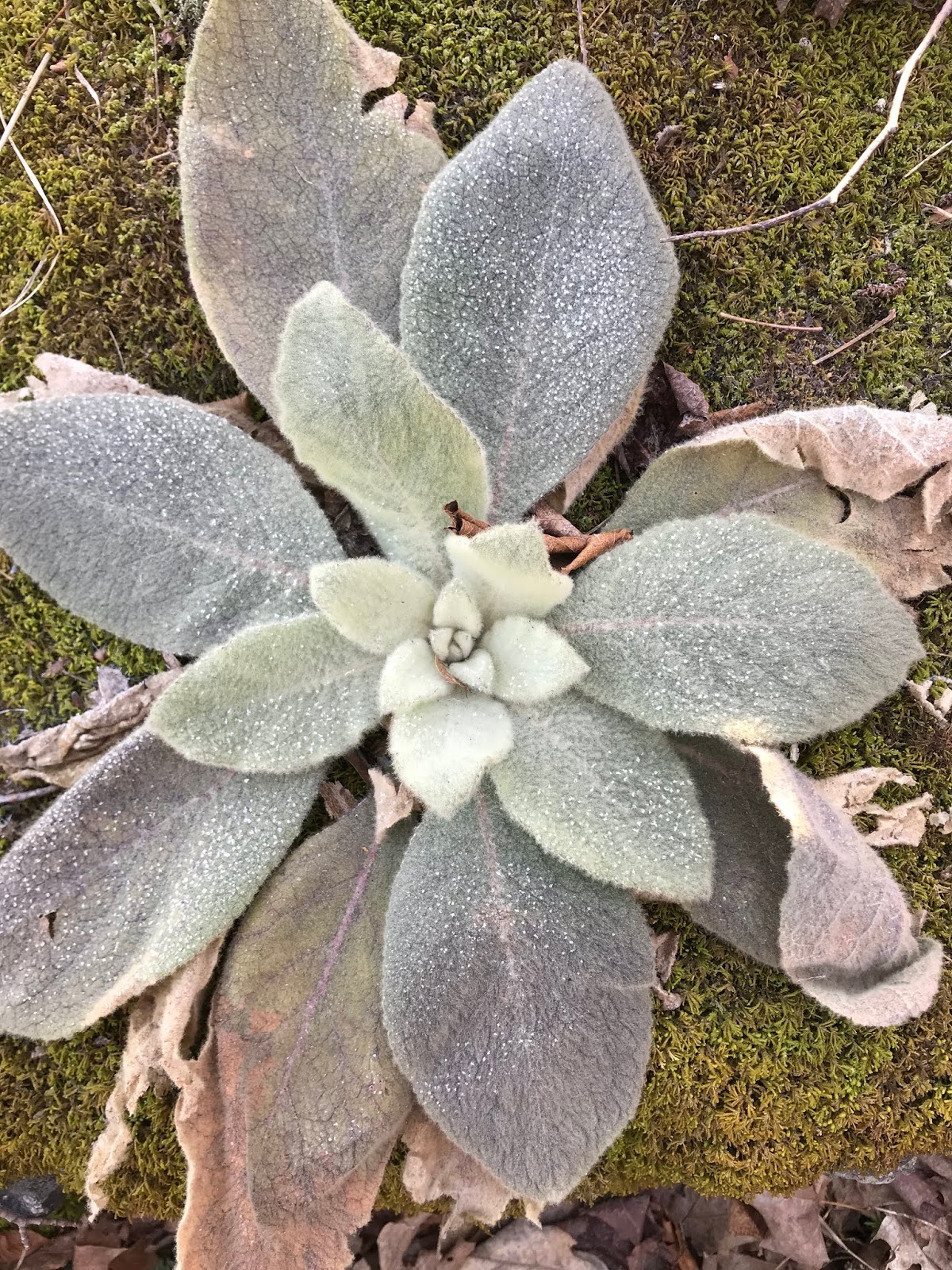
Today's tip: Mullen is Nature's toilet paper (although it doesn't seem to be around when it is needed.
Mullen
Louth Falls

Sadly Bogey did not appear
I really appreciated the sign though

Sunday, March 15, 2020

Day 2 - March 15th

Gorgeous sunny day!! Cooler than yesterday; high of 2 C, windy in exposed areas and hot in sheltered sunny areas.
Reflections of the day: Exhilarating!! 25.3 km of mud, mud, mud with spectacular hikes through hardwood forests, trees and shadows an array of vertical majesty, along creeks in the woods, and a hydro damn and lake with a sandbar in the middle and gulls squawking, two waterfalls. We hiked on city streets, country roads and along side the Welland Canal. We lunched at the First Nations Peace Monument by friendsoflaurasecord.com... (those of us on the sunny side were warm, the rest froze) There were several bridges, one of them the "Laura Secord Bridge" and some impromptu history lessons which I've already forgotten...
Uneven terrain made my ankles ache, same as yesterday but since they eased off after some stretching, cbd ointment and tlc I think they'll be better every day:-)


Saturday, March 14, 2020

March 14th - Day 1

Day 1 Bruce Trail


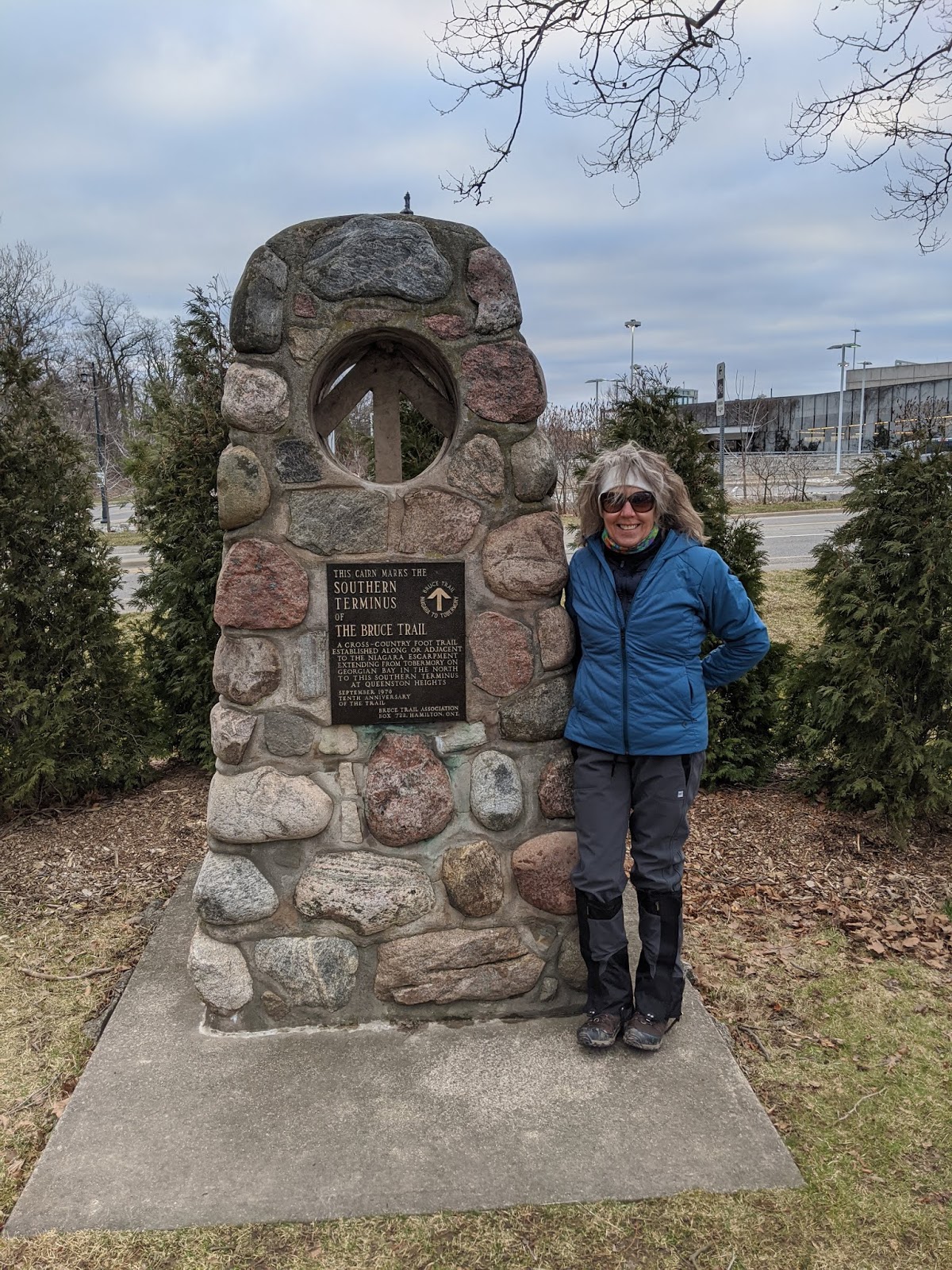
We met at Queenston Heights Park, South Cairn, the Niagara end of the trail. It was a relief to actually get started, with all of the event cancellations due to the Corona virus it would not have been a big surprise if this adventure got cancelled as well although we all agreed that being out in nature hiking on the trail is the best place to be to stay physically and mentally healthy.
We carpooled in 4 cars to our start point for the day and then hiked back to the Queenston Heights Cairn mark.
Great weather, a sun cloud mix, it warmed up to about 6 C during the day. Started hiking at 8:25 and finished around 1:40. Almost 20 km (a little longer than planned because of a BT reroute.)
 There were some cool sights along the way, the old Welland Canal, crumbling in places and so narrow it is hard to believe it could have been used as a shipping route. There was an ancient rusted out car nose dived into the canal. A tree with all kinds of shoes nailed up its trunk. Skates, ski boots and other sports footwear.... Why??? We hiked through a creek that was running through the “screaming tunnel” a cement culvert underpass of the Grand Trunk Railway. Apparently part of the Dead Zone movie was filmed there. It was kind of creepy, glad it was daylight and it was also stinky, like there may have been some sewer/septic?? Runoff in the boot high water. We could walk along the edge without getting soakers.

The trail was quite muddy in parts, very happy to have the gators, and poles cause it did get a little slimy slippery on hills. There were hills for sure, apparently these were nothing compared to the northern part of the trail but more than enough for me on the first day.


Early in the day we spotted an antique green metal lampshade lying a few meters off the trail. Most of us thought it was junk, but one lady said it was just what she was looking for so she carried it the rest of the way, about 15 km. (When we did get to the parking lot at the end a couple in a car stopped and asked her if it was for sale…)

In a particularly goopy muddy area we passed through one of the men ahead came back looking for his glasses. Miraculously they were found, Marie picked them out of the mud where only about an inch of one arm was sticking up. Not sure how many of us trod on them, they will need quite a repair job.

We stopped for lunch on some stairs overlooking a beautiful small lake. Not a sign of ice on it, a fisherman was prepping to try his luck and we saw a Turtle swimming!! March 14th … go figure!

At the foot of the biggest hill we had to climb, on a log were 4 women and a dog, drinking wine in
silver goblets (not the dog) and snacking. I’ll just say that we didn’t have wine and some of us may
have been a little envious as we scrambled up a very long steep slope.
On a fallen tree trunk there were hundreds of little puff balls, the size of a thumbnail, and that poofed
out green dust when you squeezed them. 
Very happy to see the parking lot and the little blue car at the far side. Can’t wait for tomorrow, h
ope my legs feel the same way in the morning!